Why forward-thinking insurers are replacing tightly coupled middleware with agile, scalable, event-driven platforms and what it means for operations, delivery speed, and the customer experience.
The Integration Bottleneck Holding Insurers Back
The challenge is not the business platforms themselves, but the increasing complexity of how applications exchange information across the enterprise. Tightly coupled, point-to-point integrations may have supported earlier business needs, but they become increasingly difficult to scale as ecosystems evolve. Show slow releases, rising maintenance costs, cascading failures when one system hiccups, and zero visibility into what’s actually flowing through the integration layer. When operations teams need engineering involvement to recover a single failed transaction, something has gone fundamentally wrong.
This is the challenge one leading insurance carrier faced and the reason they partnered with Exavalu to reimagine their integration architecture from the ground up.
“Tightly coupled integrations age poorly. As product portfolios and transaction volumes grow, the seams start to show and so does the cost.”
Event-Driven Architecture: The Modern Alternative
Event-Driven Architecture (EDA) flips the traditional integration model on its head. Rather than systems calling each other directly, every action—a policy update, a new claim, a customer touchpoint—publishes an event to a central broker. Downstream systems subscribe to only what they need, processing events asynchronously and independently.
For insurers, the implications are significant:
Guidewire and Salesforce decouple completely; changes to one system no longer require re-engineering the other.
New products, partners, or channels can be onboarded without touching existing integrations.
Producers and consumers scale independently, so peak transaction periods don’t create system-wide bottlenecks.
A canonical domain data model reduces mapping complexity as new integrations are added over time.
The result is an integration landscape that grows with the business rather than constraining it.
Operational Visibility: The Missing Piece
EDA also solves a problem that pure architectural discussions often overlook: operational control. In a complex integration environment, when something goes wrong, who fixes it—and how fast?
Exavalu built a centralized Operational Control Portal that provides operations teams real-time visibility and control across business transaction flows. What previously required extensive investigation and manual recovery can now be addressed through self-service operational capabilities.
Business Results That Matter
The event-driven transformation delivered measurable improvement across six dimensions of insurance operations:
Scalability: elastic, on-demand scaling replaces hard capacity ceilings.
Delivery agility: new integrations launch without impacting existing consumers.
Operational visibility: real-time, end-to-end transaction tracking across every system.
Incident resolution: failed transactions recovered in minutes via self-service replay.
System coupling: fully decoupled producers and consumers, eliminating fragile dependencies.
Future readiness: the platform is positioned for microservices, cloud initiatives, and AI-driven event processing.
New insurance products go live without re-engineering integrations. Customers and partners are onboarded in days rather than weeks. The entire integration landscape operates with lower overhead and greater reliability.
Is Your Integration Architecture Ready for What’s Next?
If your organization relies on Guidewire, Salesforce, or any combination of core insurance platforms, the question isn’t whether to modernize your integration layer, it’s how quickly you can afford not to. Legacy middleware that worked five years ago is already a constraint on your ability to launch products, serve customers, and respond to market change.
Exavalu’s Integration Practice has deep, hands-on experience designing and delivering event-driven architectures for insurance carriers, from strategy and architecture through build, testing, and operational handover.
Ready to see what a modern integration landscape looks like for your organization? Contact us at info@exavalu.com or visit www.exavalu.com.
Agile enterprises have spent the better part of a decade investing heavily in continuous testing platforms, yet industry research shows a frustrating pattern: automation coverage eventually stalls. Industry data reveals that most organizations plateau at roughly 25% automation coverage for their testing pipelines. The tools themselves aren’t failing; the static architecture underneath them is.
Where Legacy Frameworks Break Down in Sprint Cycles
Traditional frameworks operate on the outdated assumption that software interfaces change slowly enough for a human-written script to remain valid over time. Modern agile delivery completely smashes that template. With sprints compressing release cycles into days and CI/CD pipelines pushing code multiple times an hour, interfaces evolve constantly. When every minor UI tweak shatters an existing test script, QA teams get trapped in an endless cycle of maintenance, turning testing into software delivery’s ultimate bottleneck.
Shifting from Scripted Bottlenecks to AI-Augmented Autonomy
To break through this structural ceiling, the industry is undergoing a massive re-platforming toward genuine autonomy. Analyst data projects that 70% of enterprises will integrate AI-augmented testing tools into their engineering toolchains by 2028, up from just 20% in early 2025. Modern Quality Engineering (QE) is shifting intelligence away from static scripts toward self-optimizing frameworks that generate test scenarios straight from user stories, self-heal automatically when code changes, and prioritize coverage based on real-time business risk.
“The organizations breaking past the 25% automation ceiling aren’t testing more. They’re testing differently.”
The QE Response: Building for Durable Change
This industry shift shapes how platforms like Exavalu’s ExAite™ are built. By replacing brittle, legacy frameworks with self-evolving, toolchain-embedded agents, the goal of modern QE shifts from nominal automation coverage to genuine automation durability. For engineering leaders benchmarking maturity, the real question is no longer how much of your pipeline is automated, but how much of that automation requires a human script-writer to keep working five sprints from now.
Why Generic AI Testing Fails to Interpret Core Logic
A generic AI testing tool can easily identify a button on a web page, but it cannot interpret a GOSU business rule. This technical distinction is becoming one of the most critical challenges for insurance carriers navigating core technology modernization.
The High Stakes of Cloud-Native Core System Modernization
The mandate to modernize core insurance systems is clear. Legacy frameworks built for a slower, paper-driven era leave carriers burdened with severe operational inefficiencies and rising IT maintenance costs. To meet market expectations for real-time responsiveness, such as instant quotes and rapid claims payouts, insurers are accelerating the migration of legacy core systems onto modular, cloud-based platforms like Guidewire. Industry data confirms this mass migration, showing that insurers are heavily leveraging specialized ecosystem partners to achieve cloud-native scalability and agility.
“A test automation tool that can’t read a GOSU rule is testing the screen, not the policy.”
Deconstructing the Complex Layers of Guidewire Implementations
Modernizing the core infrastructure is only half the battle; the real complexity lies in validation. A Guidewire implementation is completely bound to intricate GOSU business rules, complex PCF screen layouts, and deeply layered product models specific to lines like P&C, Workers’ Compensation, and full Insurance Suites. A generic testing tool can record a cursor path, but it lacks the domain context to understand why a screen appears for a specific policy type, or how a single rate-table change cascades into downstream scenarios. Every platform update from the cloud vendor risks breaking generic automation, requiring massive manual rework.
Closing the Business-Logic Gap with Domain Intelligence
This gap is why the insurance sector requires a Domain-Aware Quality Engineering approach. Modern QE architectures utilize specialized platform and domain intelligence to inherently understand insurance constructs. Platforms like ExAite™ build this domain fluency directly into the testing layer, using prebuilt, productized accelerators designed to auto-generate tests from GOSU rules, PCF screens, and specialized workflows. Generic tools close functional gaps confirming a screen loads. Domain-aware QE closes business-logic gaps confirming a policy rated correctly and a claim routed to the right workflow. In a regulated market, closing the business-logic gap is what prevents audit findings and costly processing errors.
Testing Guidewire applications has always proved to be a challenge due to these applications’ inherent complexities. These include stringent regulations, frequent business rule updates, and the need for seamless integration across the three core Guidewire suites—PolicyCenter (PC), BillingCenter (BC), and ClaimCenter (CC).
Automating these applications presents additional challenges. These include selecting the right tools, determining the appropriate type of automation (unit testing, regression, UI, or API testing), achieving optimal automation coverage, and determining who the primary users of the scripts will be — the QA team or the UAT team.
Moving forward with automation is only half the battle. Without a well-designed framework, users often encounter a new set of challenges — from maintenance headaches and frequent changes to scalability limitations and version upgrade issues.
What’s Next After Designated Functions?
When starting your Guidewire automation journey, designated functions often become the go-to choice. They offer a solid starting point but let’s be honest — they provide minimal test coverage.
The real challenge? Determining what to automate next.
Should you focus on discounts or underwriting (UW) rules?
Will automating UI validations provide enough coverage?
Could rate testing automation allow you to avoid the tedious grind of repetitive tests?
And what about defect detection? What kind of test suites will detect the most issues?
The big question remains — how do you find that elusive ‘sweet spot’? The optimal test suite maximizes coverage without ballooning your test case count.
A mature solutions provider in the Guidewire testing space can help with the approach, based on their experience in working with multiple insurance carriers spanning across different LOBs.
Exavalu, a digital consulting and solutions provider for insurance organizations, has developed a solution to address these challenges. With extensive quality engineering experience and expertise, Exavalu has implemented test automation solutions for many insurance clients. By leveraging collective knowledge, we have built a repository of test artifacts and best practices drawn from industry leaders.
We have encapsulated this expertise in our proprietary product – GT-EX.
What Does GT-EX Offer?
Pre-built test assets to ensure rapid compliance.
Out-of-the-box test cases covering a wide range of business modules.
An automation-first approach with a robust end-to-end testing framework and architecture.
A scalable solution designed to support periodic Guidewire version upgrades.
Synthetic data creation tools and seamless DevOps integration for enhanced efficiency.
Exavalu’s solution flexibly meets the needs of customers at different levels of automation maturity. Additionally, our solutions ensure transparency in outcomes and benefits, supported by a fixed price model.
With GT-EX, we empower insurance organizations to achieve efficient, scalable, and cost-effective Guidewire test automation, driving faster time-to-market and improved software quality.
JumpStart:
Suitable for customers with little to no automation.
Core Features:
Scalable framework
Fully functional smoke test suite
Coverage for all three Guidewire suites (PC, BC, CC)
Compliant with Guidewire mandated test coverage
Foundation:
Suitable for customers that have automated basic transactions but face challenges with scaling.
Core Features (including all features from Jumpstart, plus):
A regression suite covering the most critical functionalities
CI/CD integration with Guidewire Cloud Console
Easy version upgrades
Elevated:
Suitable for customers that want to accelerate automation for both functional (in-sprint) and regression testing.
Core Features include all features from Jumpstart, plus:
Pre-defined feature files (test suites) for multiple business modules
A comprehensive regression suite covering all business modules and aligned to industry standards
Synthetic test data generators
Test coverage for digital
Conclusion:
Guidewire test automation is critical for ensuring the reliability of testing across the platform. Given the complexity and constant evolution of Guidewire applications, selecting the right set of test cases is essential. With GT-EX, Exavalu delivers a purpose-built solution that not only simplifies automation but also empowers organizations to drive continuous quality at scale.
By adopting the right automation strategy, you can accelerate your digital transformation journey with confidence.
Within the P&C Insurance industry, carriers who have invested in Guidewire core modernization are making a strategic transition to Guidewire cloud, some through a lift-and-shift approach to transition urgently, while others are taking thoughtful steps to first remove technical debt and retrofit their self-managed customization, before migrating to Guidewire Cloud. In both cases, the journey comes with its unique challenges because running a core insurance system in the cloud challenges the traditional operating model for IT application management. Carriers who are embarking on this strategic initiative must radically transform their application life cycle management to accommodate modern, frequently changing SaaS software in a highly regulated industry such as Insurance.
Additionally, the reliance on a multitude of other eco-system software partners that integrate with Guidewire necessitates efficient ways of test coverage and planning, test case management, and test automation along with additional challenges for monitoring, performance management, and information security assurance.
Migrating a core insurance platform to the cloud requires a modern Quality Engineering philosophy and multiple tools and frameworks that enable the carrier to efficiently gain value from the SaaS software through advanced DevSecOps capabilities.
This Exavalu white paper offers a well-defined three-step framework that P&C carriers can follow to ensure that a migration to cloud realizes the best possible outcomes by recommending a transformation of traditional Quality Assurance practices.
Our pioneering framework includes a detailed gap analysis of current-state quality management processes, a practical and impactful future-state quality engineering roadmap, and a partnership model to support carriers in implementing practical steps and ensuring a Cloud-proof Guidewire Quality Engineering solution framework. This framework can also be leveraged by P&C carriers who are already on Guidewire Cloud, for making their Quality assurance approach more robust and aligning with the demands of a Cloud/SaaS environment.
Guidewire Cloud Readiness is a complex transformation that goes well beyond the core
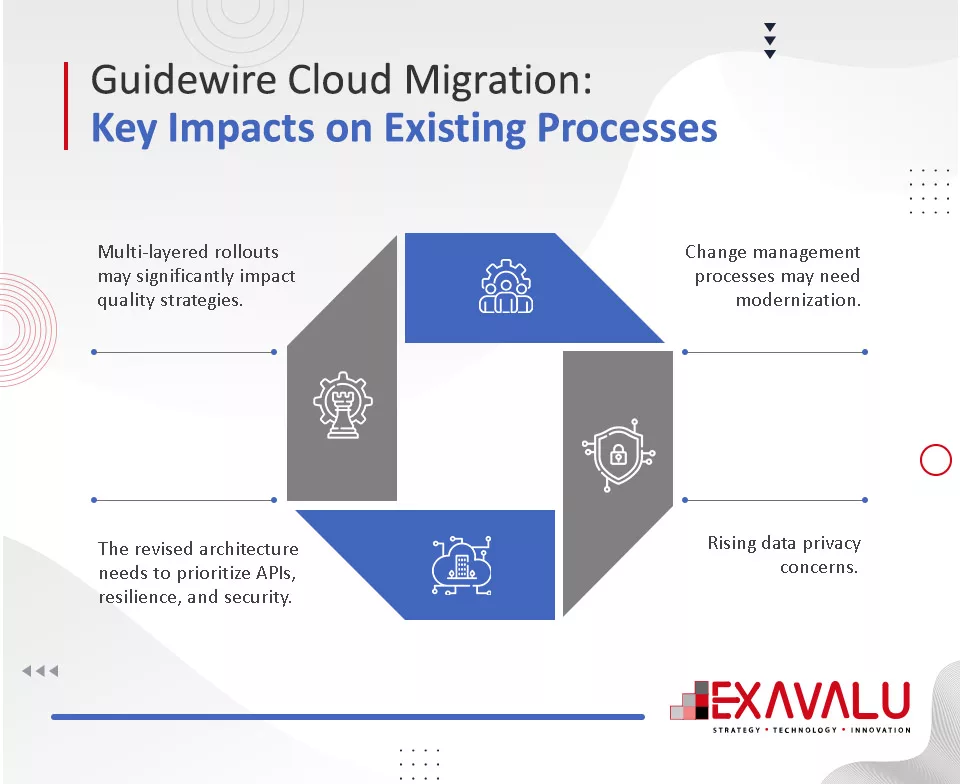
The journey to Guidewire Cloud is not just a technological transition; it needs a fundamental rethinking of IT application management and product development. This causes significant demands made on existing SDLC processes and operating norms. Some of these challenges are:
a. Multi-layered rollouts deeply impact Quality strategies
The P&C Insurance industry is going through some significant churn. Climate hazards, rate pressure, and talent scarcity are negatively impacting growth and combined ratios for the carriers. Carriers need to become more innovative in their use of advanced technologies and InsurTech solutions while respecting the cross-functional processes that make them successful. This makes an already complex process even more complex. Market penetration implies more state rollouts. IT modernization means complex data conversion initiatives. Additionally, the need to improve products and rates necessitates a complete pricing refresh. More frequent product launches require added rate management agility and process improvements. Software testing and User Acceptance Testing strategies will therefore need to ensure effectiveness and efficiency at the same time through advanced frameworks and modern test automation tools. Leveraging value from more frequent upgrades requires being prepared to test, accept, and roll out new features more quickly without drastically increasing the cost of quality, compromising product quality, or causing compliance issues.
The automation approach therefore must follow a dual-shift philosophy; a Shift-Left mindset involves developers early in the process through Test Driven Development (TDD) practice, while a Shift-Right model enables collaboration with Business teams by involving them in the Business-Driven Development (BDD) framework. A highly effective and modernized quality engineering capability for Guidewire cloud involves complementing Guidewire’s GT framework with additional open-source QA Automation frameworks for maximum effectiveness.
b. Modernizing the Change Management Processes
While Guidewire Cloud offers a great platform for operational scale and access to innovations, the new operating model requires a rethinking of the existing change management processes. More frequent upgrades and lack of complete visibility to areas of software change will put undue pressure on the quality assurance teams, therefore they will need to adapt by modernizing and accelerating their ability to accept changes while avoiding software risks.
c. Revised Architecture needs to focus on APIs, resilience, and security
Migration to the cloud will fundamentally alter the application architecture of the carriers over time. The need for open and composable architecture necessitates the removal of monolithic, point-to-point integrations and legacy data integrations. APIs change the way information is exchanged between applications that will operate in a hybrid cloud environment. The number of integration points, therefore changes exponentially and the inability to architect a cloud-ready integration framework will adversely impact the cost of ownership. Solutions such as microservice virtualization, API management tools, and a higher degree of operational resilience require a modern API management framework that forces a refactoring of legacy integrations to allow for improved scalability, manageability, security, and monitoring of real-time, mission-critical integrations.
d. Data Privacy
With the Cloud comes great power. With great power comes greater responsibility for the IT custodians, particularly in a heavily regulated financial industry. Thus, carriers need to think about how to build zero-trust security as an ongoing discipline that guards the movement, storage, and transfer of sensitive information. While cloud security assurance becomes mandatory when the carrier is no longer the true custodian of the sensitive policy and claims data, ensuring security and compliance of the SaaS software requires strengthening the principles of Data Protection and Management once carrier data moves to Guidewire Cloud.
e. Modernizing CI/CD to reengineer Release Management
Carriers are striving to turbo-charge their product development speed and pricing flexibility to remain competitive. Operating your most mission-critical software in the cloud requires a consistent culture of continuous deployment to empower the business to operate with speed while remaining compliant. Continuous deployment, not just for Guidewire, but also for all the surrounding subsystems, needs to be enabled through continuous integration some of which is managed by Guidewire and some that are managed by the carrier’s internal teams. A robust Quality Engineering framework is needed to ensure maximum test automation, ensuring a smooth transition to new integrated releases through the DevOps model.
Quality Engineering for Guidewire Cloud can no longer be supported the old way
P&C carriers have a promising business growth potential to be realized by their strategic move to Guidewire Cloud. They will need to be attentive to the challenges that such a change is accompanied by. It is imperative for them to recognize the need for a robust and thoughtful Quality Engineering strategy to address these challenges in a proactive manner because Quality needs to be at the core of any customer-centric philosophy.
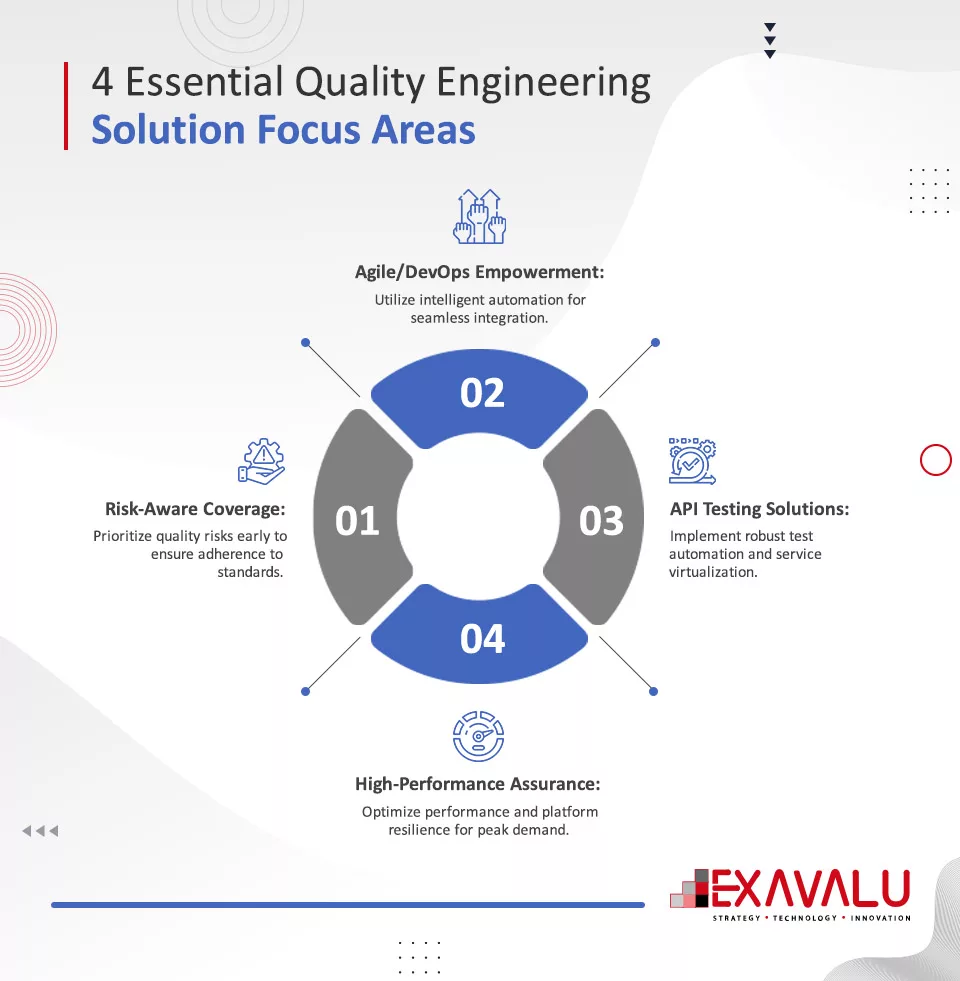
Addressing the Quality effectiveness and efficiency needs for P&C products and services on Guidewire Cloud is a complex problem statement, that calls for process and tools modernization as well as an equipped workforce. To address the challenges, the Quality Engineering solution approach needs to address four key areas:
a. Risk-sensitized coverage
Carriers cannot test too little, and they cannot test too much. They must balance the cost of quality with the highest quality assured for each release. Business stakeholders need to be assured that the test coverage has addressed all the key functionalities across the breadth of impacted business areas. Also, with state rollouts being a critical part of the business growth strategy, the regression framework on Guidewire has to follow a trunk-and-branch test case management approach, which espouses the creation of a core repository for the parent/core state(s) and branch repositories to align with the subsequent states for the products being rolled out. The test design approach also must lend itself to the ability to do intelligent test management, which is all about choosing the right set of test cases to be executed in alignment with the scope of a particular release.
b. Agile/DevOps enablement through Intelligent and Inclusive Automation
The Automation strategy under the broader Quality Engineering philosophy for Guidewire Cloud must completely enable the Agile model of rolling out products. Quality Engineers positioned within Product Pods have to function as Software Development Engineers in Test (SDETs), who can influence the Automation strategy and design, work on Automation scripts while the user stories are being developed, can bring the power of predictive analytics to the Quality approach, and play the championing role when it comes to rolling out high-quality products. They must push for maximum automation in regression to drive a completely automated pipeline which will underpin the culture of Continuous Deployment on Guidewire Cloud.
c. Test Automation solutions and Service Virtualization for API Testing
Thus, to effectively test Guidewire services and third-party integration with data providers, a robust quality engineering capability is required to conduct API testing in a cost-effective manner. Service virtualization and data virtualization solutions must be added to the quality engineering toolset to effectively test Guidewire interfaces.
d. Assurance of High-Performance and platform Resilience
Moving to Guidewire Cloud, while thousands of remote employees and hybrid web services access Guidewire, requires a robust and high-performing system that is constantly monitored by the carrier in a trust-but-verify operating model. Regular non-intrusive and integrated stress testing, and the necessary load testing after each release, is required at a cost-effective and efficient manner that ensures service resilience. This can only be ensured if carriers think of performance as a core platform feature, and not as a non-functional requirement. Performance Engineering mindset is a mandatory requirement and product owners need to think about building end-to-end performance into the core platform. The other key aspect to consider is to ensure the security of the data in the cloud platform.
With a multitude of threat actors on the rise, security must be built into the carrier’s DevOps model, thereby mandating the culture of DevSecOps. A modern approach to Quality Engineering using an integrated people, process, and technology modernization requires a constantly evolving competency addressing these critical aspects as well.
Envision and implement Cloud-Ready Quality Engineering through a 3-step Assessment-Implementation framework
Given the complex set of challenges to address, when operating a sophisticated digital insurance core platform in the cloud, carriers need to commit to becoming cloud-ready across the carrier’s entire SDLC spectrum. Carriers must apply a systematic approach to understanding the past SDLC practices, analyze the present gaps, bottlenecks, as well as tool and process inefficiencies, and move rapidly to a cloud-ready operating model for quality engineering and assurance in ways that embrace the modern Guidewire software lifecycle.
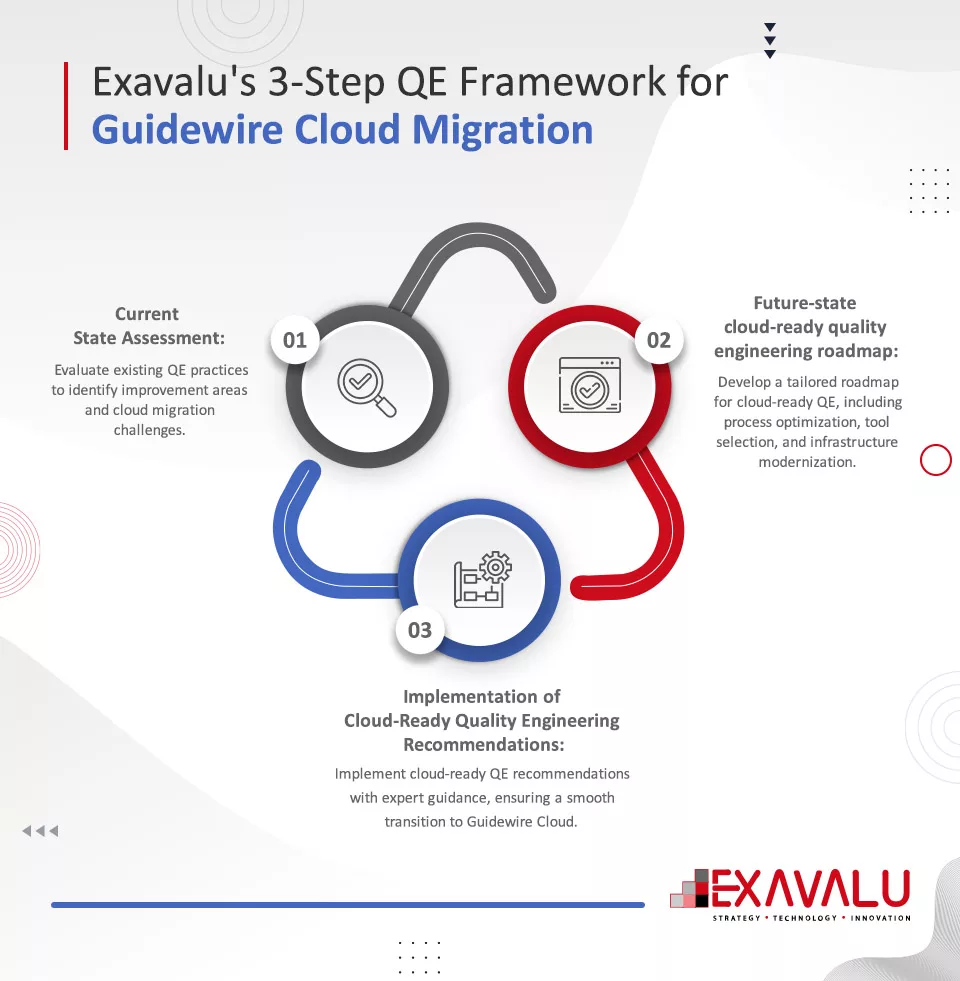
Exavalu offers a systematic, 3-tiered, approach to help carriers make the most of their investment in Guidewire Cloud with the intent to increase innovation and business agility.
Step 1: Current-State Assessment
As the first step of the framework, a team of Guidewire QE experts will do a detailed fact-gathering of Quality assurance processes currently followed on the Guidewire Cloud instance for all the 3 Guidewire Centers. The focus will be both broad and deep and will cover as-is tools/framework usage including GT and any other solutions, regression coverage from the perspective of business functionalities as well as automation %, the existing approach to end-to-end automation, and the current framework’s ability to ensure performance engineering and security assurance requirements. There will also be reviews of the current workforce’s readiness to drive Quality Engineering on Guidewire Cloud, and the efficacy of the Metrics to drive business outcomes.
This phase of the assessment will help carriers understand, through an impactful report, where they currently stand with respect to a best-in-class Quality Engineering solution framework for deriving the maximum benefit of the Guidewire Cloud eco-system. The report will assess the carrier’s quality of test design, the presence (or lack of) of an Automation-First philosophy, the degree of collaboration between Development, QA, and Business, and current tools and technologies.
With a clear picture of the current state thus established, the Exavalu team will move to the second step of the process to define a future-proof Quality Engineering operating model for the organization. This future-state Cloud-Ready roadmap will cover:
Strategy to make Test Automation Intelligent, Inclusive, and Integrated.
End-to-end Automation strategy enabling the best outcomes to be derived out of GT framework and a complementary set of open-source tools, thereby ensuring effectiveness as well as efficiency.
Enable and amplify collaboration between Business Product teams and technology teams.
Actionable recommendations for Performance Engineering and DevSecOps capabilities.
Plan to move to a Predictive and Proactive Model to build high-quality products.
Transform workforce from testing competency to Quality Leaders by propagating an SDET mindset, who can fully support a robust Quality Engineering framework for Guidewire in the Cloud.
Establish the leading and lagging indicators and metrics that are designed to ensure ongoing quality improvements through automation and quality effectiveness.
Step 3: Implementation of Cloud-Ready Quality Engineering Recommendations
Exavalu’s Guidewire Quality Engineering CoE operates based on thephilosophyof partnering with carriers in their long-term and transformative journey to Guidewire Cloud. As the third and final step of the Cloud-Ready Quality Engineering transformation, Exavalu can assist in the enablement of the future-state recommendations in two steps:
Undertake a Proof of Concept to demonstrate the value of an Automation-First Quality Engineering approach using high-impact automation scripts and modernized testing frameworks and tools.
Based on the consensus around the outcomes of Step A, Exavalu can implement the full suite of recommendations around Process, Tools, and Workforce.
Exavalu has successfully implemented this framework for a US West-based carrier to achieve over 30% QA cost savings while improving test coverage and accelerating the carrier’s ability to accept frequent Guidewire updates with confidence in the quality before deploying the update to production. Additionally, this framework has enabled carrier CXOs to feel more confident about IT’s ability to maximize the benefits offered by Guidewire Cloud.
Conclusion
A Modern and Cloud-Ready Quality Engineering framework is essential to ensure the promised value from Guidewire Cloud
Cloud has brought about a seismic shift in how modern businesses operate. With the move from on-premises to Cloud architecture, enterprises are hoping to gain the promised benefits from their cloud software vendor’s most recent digital innovations through frequent software upgrades.
The Insurance industry is at an inflection point today. Carriers are under significant pressure to accelerate innovation, improve cost efficiency and accelerate business agility. Guidewire Cloud offers cloud-native capabilities to onboard software innovations at a far more rapid pace than carriers have been operating in the past. However, for carriers to fully realize the value of Guidewire Cloud, old SDLC operating models and Quality Assurance practices will significantly impede this value realization. As IT leaders rush to the cloud, on day-two of their Guidewire Cloud operations, a realization that old self-managed software practices will not fit the promise of Guidewire Cloud will set in. This is where a smart Quality Engineering solution framework can really bring in a lot of predictability and reliability, while boosting the product rollout process. The proven 3-step assessment and implementation framework from Exavalu’s Guidewire Quality Engineering COE is designed to ensure that Guidewire customers are able to perform the necessary internal transformation to realize the value of Guidewire Cloud.
About Author
Moulinath Chakrabarty is a client executive partner with Exavalu’s Insurance practice. He has 20+ years of Insurance experience, and specializes in advising Insurance carriers on best practices for driving digital transformations with Insurance core products at the center of such initiatives. You can reach him at Moulinath.Chakrabarty@exavalu.com.
The client wanted to implement solutions to modernize the claims processing and consequently elevate the experience of their customers belonging to the E&S /Specialty portfolio.
Generative AI reshapes the way we think, with the insurance industry now embracing the potential of Generative AI. Exavalu has channeled the power of Generative AI to transform the Guidewire software engineering life-cycle. This is important since Guidewire is at the core of many P&C insurance businesses. Our GenAI-powered software engineering solution framework can enable product engineers to develop high-quality insurance products quickly and cost-effectively. Our approach closes the gap between IT and the business, making it easier for business users to play a more embedded role in the product engineering life-cycle.
Use Case Definition Based on Deep Knowledge of Guidewire and the P&C Business
We reviewed the Guidewire SurePath methodology across inception, development and stabilization. Using the knowledge from many successful Guidewire implementations, we identified two strategic themes to focus on:
Assurance of product quality
Efficiency of product engineering
We then identified a subset of focus areas under these two themes:
Assurance of product quality
Identification of the most complex functionalities that lead to code churn
Better enablement of developers and quality engineers
Collaboration between the business and IT for more precise risk coverage
Efficiency of product engineering
Acceleration of the speed of code development
Increasing the speed of test design and test data creation
Extending the value of AI to the business and people and helping them redirect their time to strategic product design
Based on this systematic analysis, we identified 4 use cases:
Defect pattern analysis to help assure product quality
An automated unit testing framework for Guidewire developers
Automated test design to assist business users
Automated test data creation to help business users, developers, and quality engineers
Collectively, these use cases cover the inception, development, and stabilization phases of Guidewire implementations, helping to ensure AI-powered acceleration and end-to-end quality. We have developed point solutions to address all of these use cases.
Use Case to Solution: A Comprehensive Journey
First, we continuously calibrated our approach through conversations with multiple clients. We wanted our solution framework to be a practical enabler for Guidewire implementation journeys. Customer feedback helped us refine our approach to ensure practical outcomes.
As we converted our conceptual design to executable solutions, we made sure to address:
User experience (with a focus on simplifying user inputs)
Smart use of Generative AI principles (chaining of prompts in the back-end)
Digital design (with the efficient use of APIs)
Best-fit public large language models (LLM) in the context of the particular use case (constant analysis of LLM outputs from OpenAI, Gemini, Claude for the use cases being optimized)
A concern for client costs (we optimized the use of tokens, relying more on pre-set libraries)
We maximized the use of our business knowledge (with test data created based on state and line of business requirements)
We have also created a framework to complete an accelerated pilot that covers:
Problem statement analysis
Solution identification and consensus
Cost benefit analysis
A step-by-step pilot execution plan
A primer for business users and IT
Commentary on security guardrails provided by public cloud providers for the LLMs (AWS Bedrock)
Conclusion
Exavalu’s GenAI-powered software engineering solution framework for the Guidewire eco-system provides a pragmatic way for insurance IT/business leadership to adopt Generative AI with minimal change management and strong assurance/engineering outcomes. With Guidewire often at the core of P&C transformations, this can become a game-changer. We can also collaborate to identify additional use cases and co-create solutions specific to our clients’ needs.
About Author:
Moulinath Chakrabarty is a client executive partner with Exavalu’s Insurance practice. He has 20+ years of Insurance experience, and specializes in advising Insurance carriers on best practices for driving digital transformations with Insurance core products at the center of such initiatives.
Our client aimed to establish a cloud-based system for their non-standard vacant home program, catering to homeowners in areas underserved by other insurers. In pursuit of this, they sought expert guidance for the seamless integration of the cloud-based platform.
The limited and patchy interaction along the policyholder claim journey poses many operational challenges for insurers whose goal is to enhance customer loyalty and retention while achieving operational efficiency and speed. Although efforts can be made to enhance customer experience through digital forms and call center support, the ultimate determinant of customer satisfaction lies in the end-to-end claims experience, which is often marred by a cumbersome first notice of loss process and many hand offs and follow up phone tagging between the adjuster and the claimant.
FNOL in insurance often serves as the policyholder’s first point of contact with their insurance carrier as a result of incurring a loss. This initial interaction can have a profound impact on insurance customer experience which may lead to attrition if not handled effectively, consistently and with speed.
A positive FNOL experience can foster customer loyalty, whereas a negative one can result in customer attrition and financial losses and ultimately damage the carrier’s net promoter score or JD Powers score among other effects.
Furthermore, a subpar FNOL experience can lead to inflated claims costs and reduced operational efficiency. Therefore, insurers must prioritize the improvement of the FNOL process to offer a seamless, streamlined and consistent customer experience, ultimately leading to enhanced customer experience and valuable operational efficiency gains.
However, before delving into potential solutions, it is crucial to gain a comprehensive understanding of the challenges faced by policyholders during the insurance FNOL.
First Notice of Loss challenges: What’s Troubling The Policyholders?
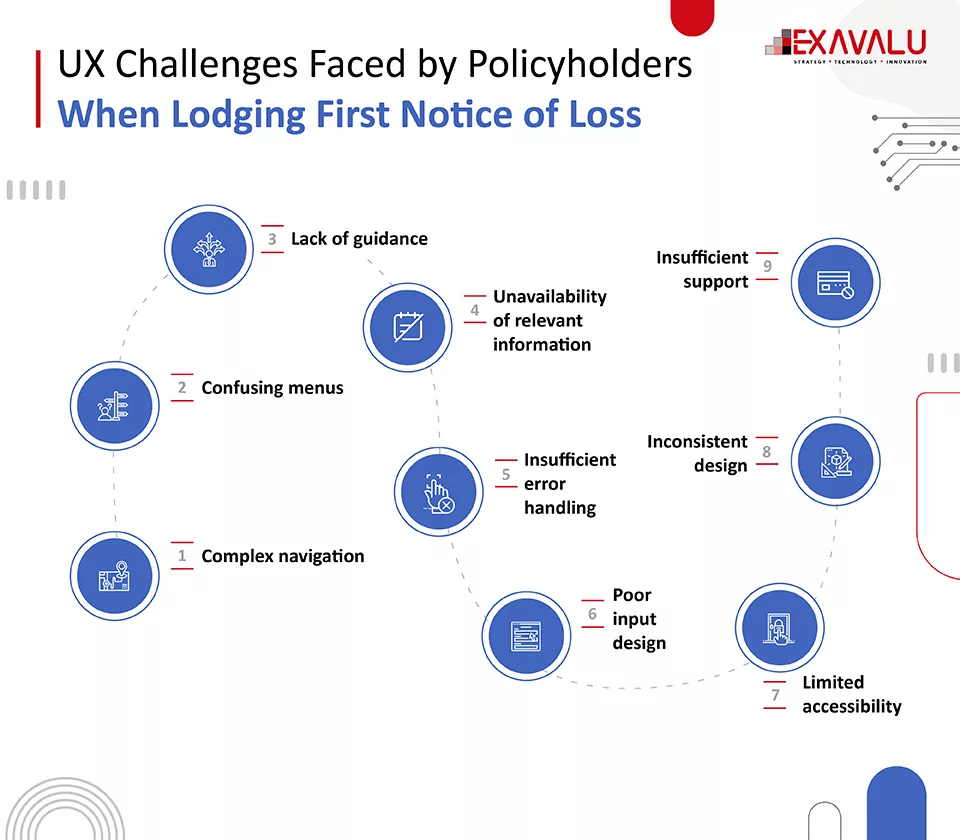
For a policyholder who has recently suffered a significant loss, the crucial elements that shape a remarkable insurance experience are ease of processing, swiftness and compassion. This is why it is important that they can effortlessly initiate the claims through an intuitive FNOL process, without any hindrances. Nonetheless, even during this procedure, the policyholder encounters a multitude of hurdles and obstacles.
A. Poor Submission Experience in Web Portals and Mobile Apps
The pivotal role of digital self-service in filing a claims FNOL cannot be overstated, as numerous policyholders prefer to personally report their losses. To streamline this procedure, insurance providers have implemented various channels, such as call centers, web portals and mobile applications, enabling customers to effortlessly submit their details and documents digitally.
Nevertheless, even these digital solutions are not immune to certain inefficiencies. Navigational complexities, apprehensions regarding the security of sensitive information uploaded online, technical glitches such as downtime and slow page loading, and the absence of mobile optimization collectively contribute to transforming what should be a seamless digital FNOL experience into a burdensome ordeal.
B. Complex Document Submission Process
The process of filing a claims FNOL involves a substantial amount of customer provided data, and currently, customers bear the burden of providing all the necessary information manually via documentation, photos and evidence information, presenting the next major challenge in the initial reporting of FNOL. Policyholders often find themselves overwhelmed with the requirement to submit numerous documents right from the start, leading to additional obstacles and delays. Ensuring that all the documents are meticulously organized and submitted correctly becomes a time-consuming and anxiety-inducing task.
Compounding the issue, many insurers lack flexibility in their digital FNOL when it comes to document submission, meaning that once an incorrect document is filed, it cannot be rectified. Consequently, when policyholders are already grappling with significant losses, the documentation stage of the FNOL process introduces an extra layer of complexity and stress, ultimately deterring them from seeking further engagement with the same insurance provider.
C. Lack of Prompt Response from The Insurers After FNOL Submission
In the realm of insurance customer experience, a prolonged delay following the initial notification of loss can wield a detrimental impact. Imagine yourself in a distressing situation, where you, as a policyholder, have placed your trust in an insurance company to provide the promised support and coverage. During such trying times, prompt communication regarding the progress of your claims request becomes imperative. However, failing to fulfill this obligation not only reflects poorly on the quality of customer service but also leads to frustration, uncertainty, and anxiety among customers. The ensuing damaging experience creates an unforgettable impression on the FNOL process flow, ensuring that when the time for policy renewal arrives, these customers will never again gravitate toward the same insurer.
D. Absence of Human Touch in The FNOL Process
Within the sphere of rapid, digital FNOL filing processes, a glaring absence becomes apparent: the invaluable presence of empathy and understanding offered by a human agent. This absence inevitably detracts from the overall quality of engagement. In moments of crisis, policyholders often require precise answers to questions related to their unique situations. Unfortunately, insurance customer experience agents and adjusters are frequently ill-equipped to provide the empathetic and meaningful assistance necessary during these times of need. The inability to offer genuine human empathy during critical moments of a digital experience can have a profound impact on customer loyalty, making it arduous for insurers to retain their valued clientele.
Unfortunately, insurance customer experience agents are frequently ill-equipped to provide the empathetic and meaningful assistance necessary during these times of need. The inability to offer genuine human empathy in critical moments can have a profound impact on customer loyalty, making it arduous for insurers to retain their valued clientele.
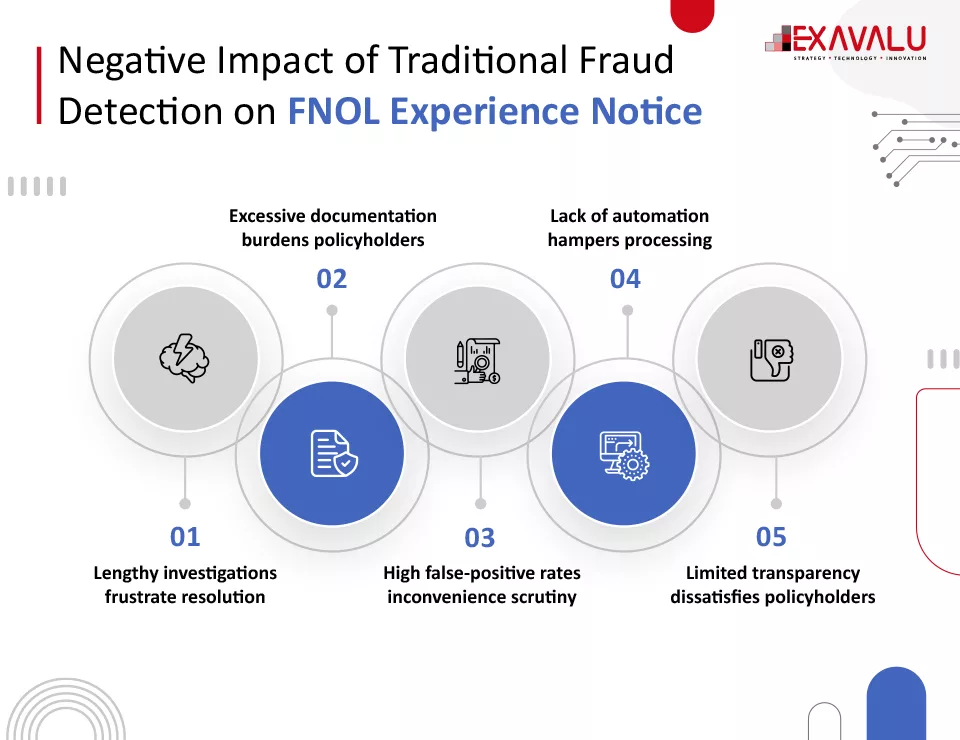
E. Manual Fraud Detection Process Resulting in Customer Inconvenience
According to the statistics, in property & casualty insurance, an astonishing sum of around $45 billion is attributed to the insidious clutches of fraud, and nearly 10% of all losses incurred in the property and casualty domain stem from deceitful claims. The archaic methods employed by insurers to combat this rampant issue only serve to exacerbate the problem, burdening the already complex process of reporting the first notice of loss (FNOL).
In their quest to fend off fraudulent claims, insurance providers often demand a plethora of additional documents and information from policyholders, subjecting even the most legitimate claims to unwarranted scrutiny. Consequently, a pall of suspicion descends upon the relationship between policyholders and insurers, casting a dark shadow over the customer experience and, inevitably, resulting in the loss of trust and valuable business opportunities.
The Solutions – Eliminating The Insurance FNOL Challenges
The challenges in improving the claims FNOL process flow are not insurmountable. Resolving the intricate issues surrounding FNOL in the insurance industry can indeed be a remarkably straightforward endeavor. By fostering a customer-centric approach and embracing suitable digital and process automation tools supplied by cutting-edge technology, insurers hold the power to eliminate these challenges. Let’s explore a few compelling avenues through which insurers can achieve this feat.
1. Improving Web Portal/Mobile App UX For Better First Notice Of Loss Experience
Insurance companies must urgently enhance the user interface of their digital web portals and mobile applications to streamline the cumbersome process of submitting a first notice of loss. This can be achieved through the implementation of intuitive design elements and captivating visual cues, coupled with explicit guidance on how to navigate the FNOL submission procedure. Furthermore, insurers must take into account the online habits of policyholders, tailoring personalized services that alleviate the anxieties and exasperations experienced by customers during challenging circumstances. By doing so, they can transform the customer experience into a more seamless and empathetic journey.
2. Streamline Data Capture & Management Process with Telematics
Enhancing the FNOL process efficiency and streamlining policyholder documentation are key imperatives for P&C insurers. To accomplish this, insurers must enhance their secure data capture, harnessing a rich array of internal and external data sources to curate comprehensive information.
Moreover, the advent of internet-connected monitoring and security devices, including smoke alarms, water sensors, thermostats, dashcams, and in-car sensors, presents a unique opportunity for insurers. By utilizing these devices, insurers can amass invaluable data that fuels the creation of predictive models and offer automated FNOL process. Consequently, this seamless integration enables precise damage assessment, prompt response times, and serves as a potent defense against fraudulent claims.
3. Improve The Response Time With Automated Communication & Chatbots
In the face of hardship, the swiftness of response holds the key to easing the overbearing weight of distress and worry carried by policyholders. Insurance providers wield a powerful tool in the form of automated messages and emails, seamlessly delivered at the very instant a first notice of loss is submitted, ensuring that customers remain informed of their claims’ progress. Moreover, the deployment of chatbots and live chat during this pivotal stage of a policyholder’s voyage provides invaluable assistance by offering automated guidance and addressing inquiries that may arise in the wake of a loss. Thus, a harmonious symphony of technology and empathy orchestrates a reassuring melody for those in need.
4. Empower Agents to Offer a More Humane Insurance FNOL Experience with Agent Facing Portal
The absence of a human touch greatly impacts the quality of the insurance customer experience. When customers find themselves in distress, it is imperative to offer them timely and appropriate human assistance. To accomplish this, insurers must ensure their agents are armed with accurate and comprehensive customer data right from the outset. Insurers can elevate the agent’s experience by implementing FNOL software solutions like an agent-facing portal that automates manual processes, provides a holistic view of customer information, and fosters enhanced collaboration across the organization. By enhancing the claims agent experience, insurers empower their agents to offer personalized guidance, improve communication, and expedite resolutions for customers, thereby significantly enhancing the overall first notice of loss process.
5. Better Fraud Prevention Techniques
Fraud prevention techniques may not directly impact the customer’s FNOL process flow, but they significantly influence the speed and efficiency with which insurers handle first notice of claims requests. Insurers need to eliminate the unnecessary complexity caused by manual fraud prevention methods and instead adopt predictive modeling and automated fraud detection systems. This enables carriers to swiftly automate the identification of potentially fraudulent claims while reducing the reliance on manual inspection.
Additionally, insurers must effectively communicate the steps taken to prevent fraud, reassuring policyholders of their protection. Clear communication during insurance FNOL process empowers policyholders, allowing them to comprehend the necessity of certain measures and what they can expect throughout the claims process.
How Exavalu can help with Improving First Notice of Loss?
The significance of a seamless first notice of loss experience cannot be overlooked when it comes to insurance success. At Exavalu, we leverage our extensive industry knowledge and technical proficiency to provide a range of inventive tools and services designed to enhance the FNOL process. Our Advisory Services and state-of-the-art digital engagement solutions, including customer and agent portals, collectively aim to elevate the FNOL journey. These groundbreaking solutions propel efficiency and customer satisfaction, revolutionizing the insurance FNOL experience to unprecedented levels of excellence.
1. Exavalu’s Exemplary Advisory Services
Our Advisory Services excel in optimizing FNOL claim process for insurance companies. With a wealth of expertise in Insurance Operations & Technology and a talented team of consultants with extensive Insurance experience, we assist clients in evaluating, recommending, and executing digital and core transformation initiatives to achieve desired business outcomes.
With a thorough assessment of existing processes, our seasoned experts provide valuable insights and recommendations to enhance efficiency, reduce costs, and elevate customer satisfaction. Our services focus on vital areas like process automation, data analytics, and seamless technology integration, resulting in a streamlined FNOL workflow. Our actionable recommendations pave the way for remarkable process optimization.
2. Exavalu’s Cutting-Edge Digital Engagement Solutions
Exavalu’s digital engagement solutions utilize cutting-edge Insurtech solutions and modern low-code and hyper automation technologies to enhance the digital FNOL experience. These solutions blend automation, advanced data analytics, and superior process optimization to improve operational efficiency and transform customer interactions.
Customer Portal: A Gateway to Excellence
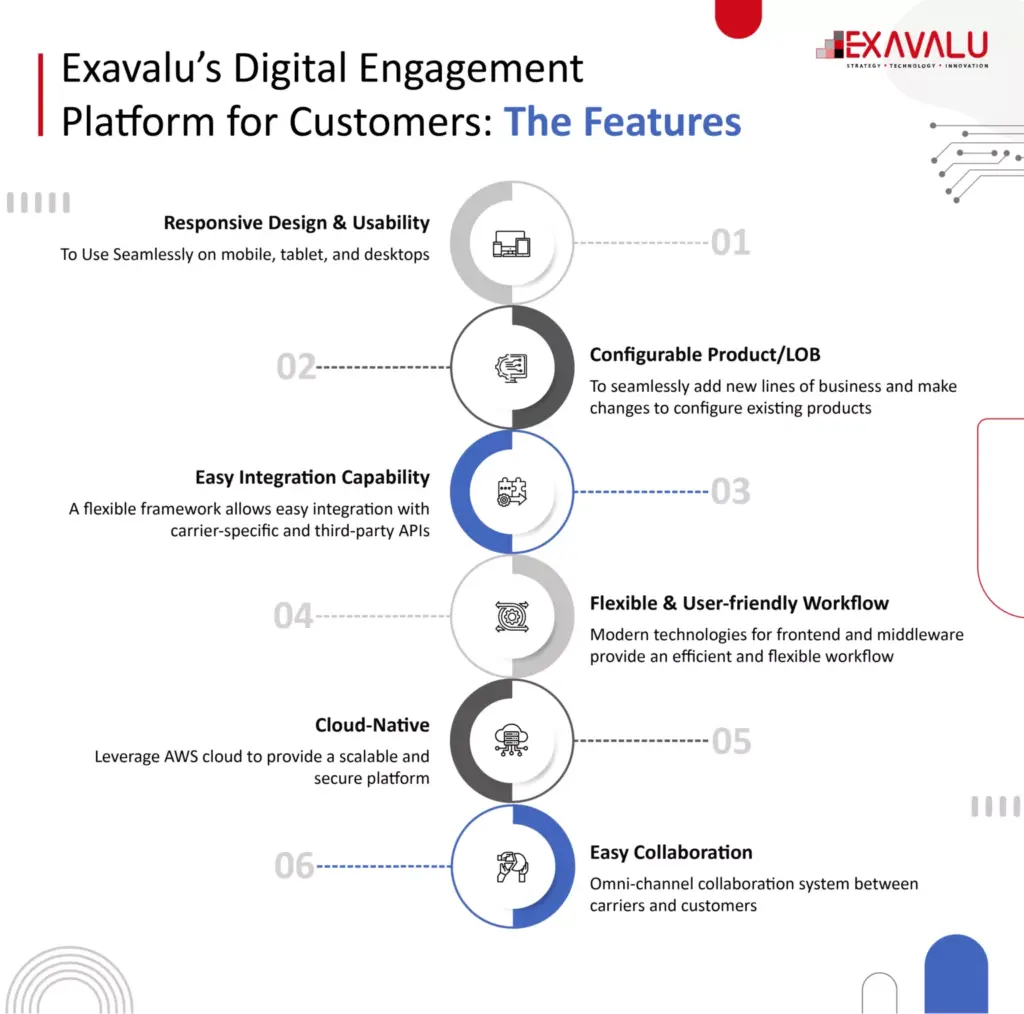
The Customer Digital Engagement Platform, designed specifically for personal insurance providers, offers a versatile, responsive, and user-friendly interface with a wide range of features that empower customers to efficiently manage their policies. Our platform ensures a smooth experience for both policyholders and insurers, allowing them to easily report claims from any device and expedite the entire process through self-service.
With its user-friendly design, customers can effortlessly provide vital information, upload relevant documents, and closely monitor the progress of their claims. The portal not only strengthens the relationship between customers and carriers and streamlines the claims reporting process, it also helps the policyholders to lodge first notice of loss in a more simplified manner.
Agent Portal: Empowering Agents with Unparalleled Expertise
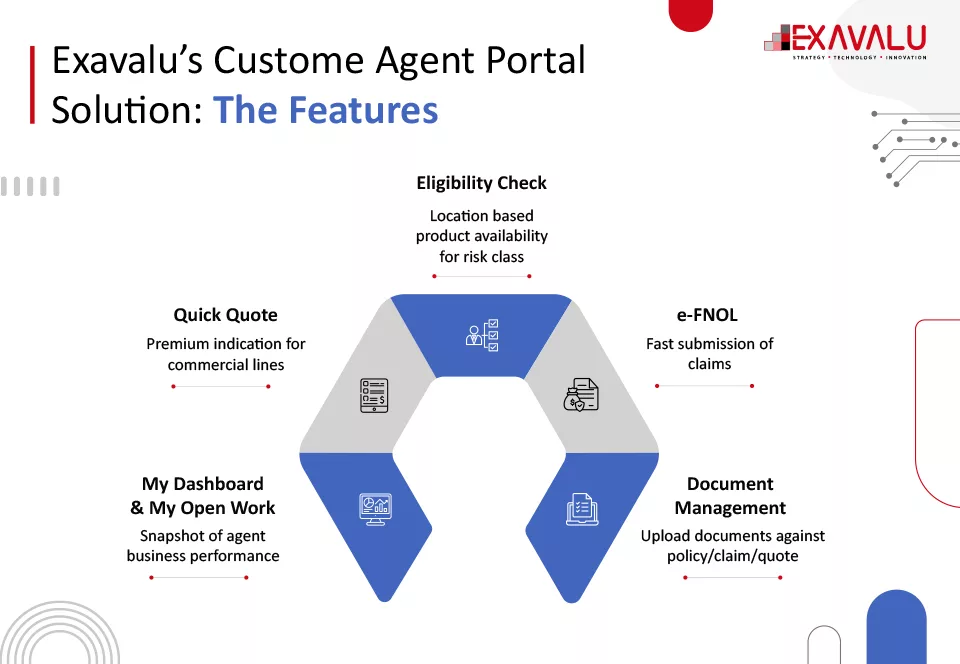
The concept of an ideal insurance agent portal extends beyond its function as a mere information repository. It strives to deliver more than just data; it aims to provide meaningful, holistic, and contextual information that agents can leverage to enhance their operations. Exavalu’s Agent Portal (watch demo video), tailored for commercial insurance carriers, places agents at the focal point of pertinent business information. With its user-friendly interface and comprehensive set of features, the portal empowers agents to efficiently manage their work processes.
By streamlining time-consuming tasks, agents can dedicate more of their valuable time to elevating the policyholder experience deliver personalized experience, especially during the FNOL process, ultimately strengthening customer satisfaction.
Revolutionizing the FNOL Process: Exavalu and Guidewire’s Strategic Partnership
Exavalu, with its deep expertise in Guidewire solutions, is poised to significantly enhance the First Notice of Loss (FNOL) process for insurance organizations. By leveraging our Exavalu-Guidewire partnership, we can streamline and optimize the FNOL process flow, enabling insurers to deliver faster and more efficient claim-handling services. Through customized configuration and integration of Guidewire’s comprehensive suite of tools, we can enhance data capture, automate claim documentation, and implement intelligent decision-making processes. This expertise empowers insurers to expedite claim registration, accurately assess damages, and facilitate prompt communication with policyholders, ultimately resulting in improved customer satisfaction, reduced cycle times, and increased operational efficiency. Our adeptness in leveraging Guidewire ensures that First Notice Of Loss becomes a seamless and impactful process for insurance companies, delivering tangible benefits across the claims management lifecycle.
Conclusion
Improving claims FNOL experience is critical to retaining customer loyalty and increasing operational efficiency for insurers. By addressing common challenges in the claims process and leveraging technology solutions and services, insurers can improve FNOL experience and reap the benefits of higher customer satisfaction and loyalty, lower claims costs, and increased operational efficiency. Exavalu is a leading provider of technology solutions and services for insurers and can help insurers achieve these goals through personalized digital FNOL processes, digital tools and automation, analytics and data-driven decision-making.