In the constantly evolving insurance industry, carriers and agencies are seeking ways to streamline operations and improve efficiency. The increasing digital expectations are calling for a rapid transformation of processes, including claims, underwriting, and customer services. CIOs and CTOs need to find new ways of leveraging Information Technology to improve operational efficiency and optimize transformational cost.
Here is an infographic to help you understand how to augment operational optimization across claims, underwriting, and customer services.
One of North America’s leading P&C insurance organizations with over 50+ million members reached out to Exavalu to elevate their subrogation recovery allocation process.
As one of the most prominent Insurance carriers in the state of California, our client wanted to provide more information about their products and the autonomy of self-service to the brokers through a custom, InsuranceNow compatible broker portal. Therefore, they reached out to Exavalu for the implementation of an out-of-the-box solution that would improve the broker experience and satisfy multiple requirements.
The client required assistance to evaluate COTS solutions for Guidewire InsuranceNow reporting solutions as well as to define a Future-State Cloud Data Warehouse policy. Additionally, they also wanted to design & develop a real-time iNow claims reporting solution.
Financial transactions are at the core of the Insurance Industry. Whether it is customers paying premiums or insurance carriers disbursing claims or refunds- a certain ease of operations is expected by everyone involved in the process. However, the legacy insurance payment processing systems used by traditional insurance carriers cannot offer the expected efficiency of payments. And that is where digital payments come in.
Already popular across retail, media & entertainment, and hospitality industry, digital payments have had a slow growth in the insurance industry. But the sudden onset of the Pandemic has made insurers realize that the future landscape of payment preference has changed rapidly.
To keep up with this change, insurance carriers must integrate digital payments within their business & IT operations as soon as possible.
Despite this awareness, there have been some significant roadblocks to providing seamless payment processing for insurance companies. Let us examine these challenges before moving on to the discussion of how insurers can accelerate digital payment integration for better customer experience & business growth.
The Challenges Of Digital Insurance Payment Processing
The benefits of digital payments in insurance range from improving customer experience, loyalty, and customer retention rates to reducing claims payment frauds. These expansive benefits of insurance payment processing have encouraged over 67% of insurers to adopt digital payments as part of their business operations.
However, before reaping the rewards, insurers must contend with some serious digital payment challenges. Let’s discuss the top 3 digital payment challenges insurance carriers need to find the solutions to before they leverage the technology for inbound and outbound payments.
1. Rising Number of Payment Methods in The Market
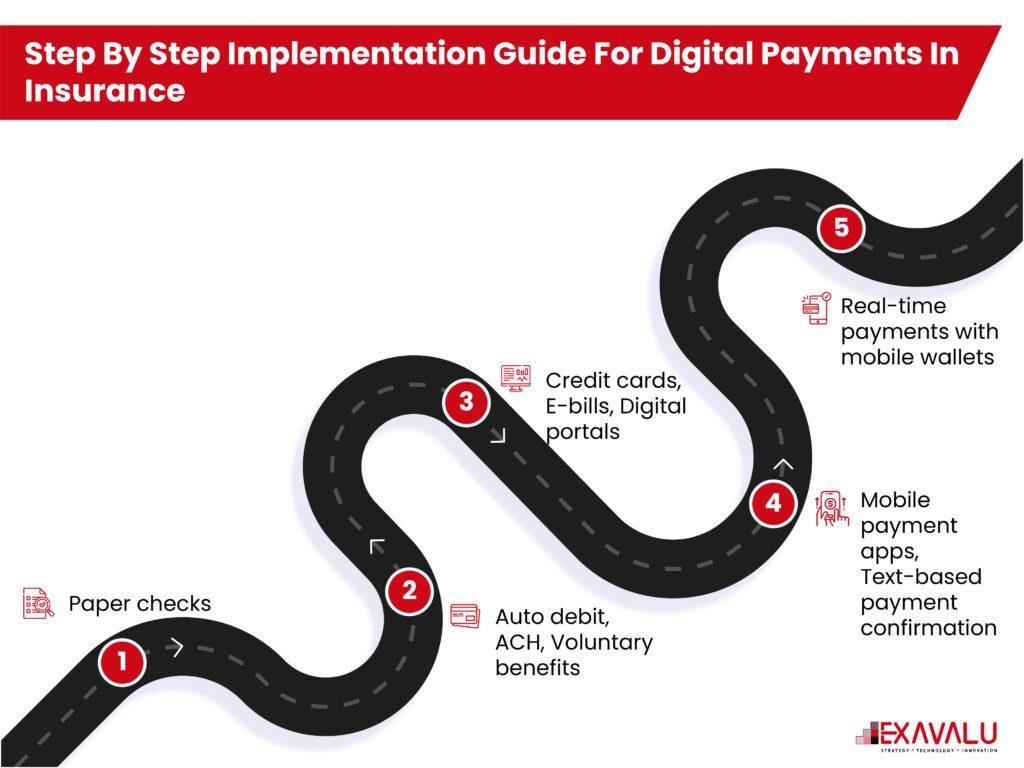
At the end of the day, digital payment is just a consolidated term for various online and touchless payment processes. Ranging from electronic payment systems such as wire transfers and eChecks to mobile payment & wallet apps, each of these payment methods has its own merits. This diversity of payment methods, however, is the first digital payments transformation challenge insurers must overcome.
In order to provide an inclusive and omnichannel experience to the wide demographic of their customers, insurers need to continuously monitor and integrate new digital payment methods within their insurance payment processing systems. However, each new payment processing method has its own requirements, and insurers need a lot of resources to integrate such different methods of payment and align their IT operations with each new payment channel. This need for continuous scalability and alignment becomes one of the big challenges in integrating digital payments.
2. IT Ecosystem Readiness To Implement Digital Payment
Over the last few years, digital payments have become synonymous with efficiency for the users, their popularity pushing the insurers to integrate them within the payment processing system for insurance. However, digital payment is not a singular feature that can bolster the entire customer experience. In fact, putting modern digital payments systems within legacy insurance IT operations might cause more problems for insurance carriers.
This challenge of IT ecosystem readiness is more prevalent among large traditional insurance providers who still entrust a big part of their business operations to complex & fragmented legacy systems. These legacy systems impose limitations and constrict efficient insurance transaction processing, nullifying the benefits of digital payments integrations. To leverage the full benefits of digital insurance payments, such legacy insurers need to digitize the entirety of their IT operations. With all the other surrounding processes modernized, digital payments will have a more positive impact on the customer & agent experience.
3. Security & Compliance
The growth of digital payments & transactions has led to an increase in online fraud that is becoming more sophisticated every day. These online frauds such as phishing, DDoS attacks, payment data theft are affecting almost every industry, including Insurance. In fact, the insurance industry is more vulnerable to cyber threats stemming from digital payments.
The chances of online payment security breaches will increase with the volume of digital transactions between insurers and customers. This, combined with the already existing legacy system-related security challenges creates a monumental obstacle for insurers who are looking to accelerate digital payments transformation. Without mitigating these challenges. It will be near impossible for insurers to integrate digital payments within the insurance value chain.
Embracing Digital Payments: What Should Insurers Do?
With over 93% of consumers considering emerging payment methods such as biometrics and contactless, digital insurance payment processing has now become an absolute necessity for insurers. The pandemic has transformed the payment behaviors of consumers and there is now a greater expectation for businesses including insurance carriers to provide flexible payment options. The demand has reached a point where customers have admitted to actively avoiding businesses that do not offer ease of electronic payment.
Besides the customer demands, the increasing need to streamline the payment processing system and eliminate claims payment fraud is pushing the insurers to make the necessary changes to their payment operations. But how are they bringing forth the changes? Let us have a look-
1. Creating Digital Eco System For Enabling Digital Payment
Insurers who have successfully completed the integration process of digital payments have done so by modernizing the rest of the business operations. For this, they had to begin by identifying opportunities and support groups, defining success parameters, and applying analytics to measure customer responses to not only improve the digital payment features but fulfill other digital requirements of the customers as well.
Without a comprehensive system in place that makes it easier to share data and make informed real-time decisions, the integration of digital insurance payment processing will not have much effect. This is why the best strategy for insurers will be to accelerate digitization for the entire system with a complete system assessment and incremental changes. With a ground-up approach such as this, insurers would be able to leverage the full benefits of digital payments in the insurance IT ecosystem.
2. Implement Security Strategies
Along with the benefits, insurers must also be aware of the security pre-requisites of digital payment integrations. As the risk of cyber-attacks, data theft, and phishing incidents increases, insurance providers must implement strong security strategies to protect policyholders from malicious online activities.
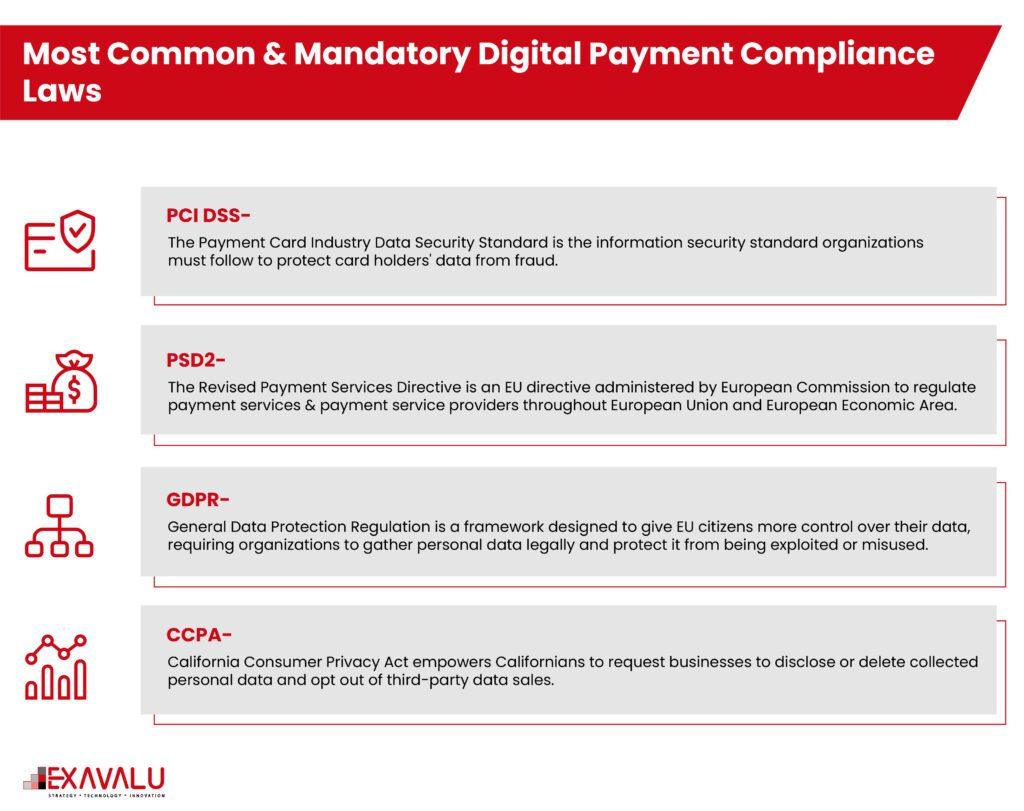
There are three different ways insurance carriers can guarantee the security of digital insurance payment processing solutions. They can begin with digital payment regulatory & compliance laws, along with the different data protection laws and regulations imposed by different countries.
At the same time, insurance providers should also follow best practices such as-
Transaction data encryption
Tokenization
Strong password protection & recovery services
Additionally, to further mitigate the risk of cyber-attacks and payment frauds, insurers can utilize AI & machine learning. With these technologies, they can continuously monitor and identify suspicious payment activity. Embracing multiple ways of securing payment gateways and transactional data will result in increased policyholder trust and operational efficiency for the insurance carriers.
3. Flexibility Of Payments Catering To Customer’s Need
The flexibility of payments is important for a good customer experience. For insurers who are imbibing a digital insurance payment processing system, flexibility is necessary to cater to the requirements of a wide range of target customers.
The flexibility preference has two sides to it- the first one being the flexibility of using different payment methods, the other one being an omnichannel experience. There are multiple emerging digital payment methods in the market along with many established ones- and they all have numerous users. These user bases are made of people from different generations, and catering to their preferences is going to be important for the insurers. Even though there are some integrational and management challenges to having multiple payment channels, insurers can begin by prioritizing the payment methods based on the target audience, their age & payment preferences. This way insurers will get less overwhelmed and follow an easy track to digital insurance payment transformation.
On the other hand, we have omnichannel flexibility. Different generations of users are used to different devices. While the baby boomers are much more comfortable with phone calls with agents and receiving checks in the mail, the more modern generations of Millennials and Gen Z want self-services and a faster payment experience- leading to different channel requirements. This difference in channel preferences can also be easily managed with a complete assessment of the target demographic and their online behavior.
To offer true flexibility of payment, insurers need to ensure that the customer can make payments from any device, using any method at any time. And to augment this, a complete understanding of their customers and their needs is going to be necessary while working on digital payments transformation.
4. Leverage Technology To Eliminate Data Reconciliation Challenges
There’s already substantial pressure on the insurance reconciliation process because of the growing transactional volume. This pressure is increasing even more due to the emergence of digital payments. That’s why insurance carriers who want to integrate digital payment systems to streamline insurance payment processing must prepare for the data reconciliation challenges as well.
Without the ability to efficiently verify & validate data collected from multiple transactional systems, insurance carriers can experience delays in adjusting claims, which leads to increased claims processing costs and reduced customer satisfaction. This is why, while digitizing the payment processing system, insurers should also consider automating the data reconciliation process. Using automation to efficiently collect, verify & validate transactional data will help insurers save resources and enhance customer satisfaction.
5. Choosing The Right Payment Service Provider
Last but not least, partnering with the right digital payment service provider remains one of the crucial steps for insurers in their digital payment integration journey. With the right partner by their side, insurers can provide a secure, fast & real-time insurance payment processing experience to the policyholders and enhance in-house business operations.
When it comes to choosing a partner, insurers should search for three things- industry experience, security & transparency, and integration costs. Having a digital payment processing partner who has relevant industry experience, offers competitive integration costs with no additional fees, and ensures security & transparency of transactions is going to be important for insurers to successfully incorporate digital payments within business operations.
Case Study: How Exavalu Helped Boutique Insurance Provider Transform Claims Experience With Digital Payments
At Exavalu, we incorporate our years’ worth of experience in digital transformation with our core insurance industry knowledge to help insurers make the best of technology.
Therefore, when a boutique P&C insurance company wanted to elevate their claims customer experience with digital payment integration, they reached out to our team of experts. Read detailed case study.
A. Client Requirement for Digital Payment
The California-based P&C insurance company was facing multiple challenges with the manual insurance claim payment process, which was affecting the back-office operations, as well as customer experience adversely. Through digital claims payment integration, they wanted to-
Achieve faster & more efficient claims processing
Enhance the claims settlement experience for the customers
Lower the operational costs caused by the legacy system
B. Our Response to The Client’s Requirements
Drawing on our experience & resources, we provided our clients with technical & business process expertise around Guidewire InsuranceNow integrations with One Inc, helping with requirement definition & overall integration.
Unique Features of The New Digital Claims Payment
Completed within an aggressive timeframe of 3 months, the solution covers multiple payment methods to offer flexible insurance payment processing to both our clients and their customers. Besides the flexibility of payment, here are some other unique features we integrated within the new digital payment solution-
Payee identification
The new system can identify the payee type when a new payment is made. This type can vary, such as insured/claimant, vendor, mortgagee, lienholder, third party carrier, etc.
Appropriate data is gathered for association based on the payee type, along with any additional requests like expediting payment or certified payments.
Payment request management
Appropriate payment requests are formulated and sent to One Inc through API calls; this is done based on the payee type.
The payment transaction with the request details is updated in InsuranceNow.
Payment response/updates
One Inc sends an immediate response on the status of the payment request, and the same is updated on the payment transaction.
Any change to the payment status is reported by One Inc and it is immediately recorded in the payment transaction in InsuranceNow, reducing complexity in the reconciliation process.
Driving Higher Customer Satisfaction with Digitized Claims Payment
Completed within a short amount of time, the Guidewire InsuranceNow integration with One Inc augmented the digital claims payment operation for our client, resulting in a sharp hike in customer satisfaction levels, while creating efficiencies for claims examiners.
Conclusion
In light of recent socio-economic upheavals and changing customer expectations, digital payments seem like the perfect first step for insurers to embrace a digital-first service model. But without an organization-wide transformation strategy in place, the singular attempt of digitizing payments will not be effective enough. To ensure sustainable growth of their business model, insurers need an experienced strategy and implementation partner by their side. And that is where we come in.
Over the years, Exavalu has enabled insurers to leverage the full benefits of digital solutions to enhance insurance payment processing, customer experience, and in-house operations. With the help of our experienced leaders and expert technology teams, we can ensure that your digital transformation initiatives benefit both your insurance organization’s employees and customers.
One of California’s Leading P&C Insurance carriers wanted to improve their customers’ claims experience by revamping Claims payments with Digital capabilities. With the core objective to provide customers with a seamless, secure, fast, and efficient claims payment service, they reached out to us for advisory & implementation services.
Our client wanted to accelerate underwriting risk score generation with improved accuracy but lacked the kind of automated scoring engine to eliminate the manual risk assessment process. The existing underwriting process was also not integrated with Guidewire PolicyCenter, resulting in inefficiencies across business operations.
Exavalu Lead Management System empowers insurers to leverage intelligent automation for incoming leads in Pega Sales AutomationTM. Insurers can deliver qualified leads to the right agent through automatic factor analysis for geographic location, historical sales rep performance, and dynamic lead scoring, and streamline workflows using efficient data processing to convert those leads into sales.
Digital transformation and increasing industry focus on customer experience is driving a renewed interest in customer data management solutions. Customer data platforms and Master data management are two technologies that are subject to a lot of debate and confusion, as they both promise to deliver on the goal of a golden customer record and enabling “360-degree” customer insights.
Master Data Management solutions have been around since the 1990’s and have gradually evolved into robust and proven solutions from leading vendors such as Informatica, Reltio, SAP and Tibco.
Customer data platforms are a more recent breed of solutions emanating from the MarTech (Marketing Technology) industry that are focused on the marketing and sales community.
This article is an extract from an Exavalu whitepaper (available on request) that examines these two technologies and provides recommendations on what is the most appropriate solution depending on your specific use-case.
For example, Customer Call Centers and help desks need to have the entire client profile right in front of them when a customer calls. They should not have to log into multiple systems to service that client.
The 360 view of the customer should provide the authoritative view of that customer and provide all of the information that the call-center specialist requires to not only help resolve the immediate issues of that customer, but also to tailor the customer experience by offering services or additional information to make the customer feel more valued and appreciated.
The challenge of identifying a unique customer
It sounds obvious, but to be able to provide world class customer service and customer experience you must first be able to uniquely identify who your customers are. Are they an existing or past customer or a new prospect? Then you need to understand their full interaction history with your brand.
Finally, advanced analytics and 3rd party data can be used to help identify how best to service and retain that customer, how best to cross-sell to that customer and which new prospects are most likely to buy your products and services going forward.
However, the first stumbling block is just uniquely identifying a customer, and it is not as easy as it sounds. For this, we need to need to be able to match customer data across multiple source systems and decide which customer records relate to the same unique customer, and which pieces of the customer data are the most accurate and up to date. Once we have that, we can then establish a ‘360 degree’ view of that customer so that we can easily see all pertinent information such as their transaction history, active policies, current claims, sales and marketing interactions etc.
Within the financial services industry, especially with legacy insurers the core systems and technologies were designed for transaction level processing, not for managing accounts or books of business. The focus was on registering a submission, issuing a policy, tracking the claims, and generating bills. These ‘core’ processing systems were also not very well integrated, resulting in a great deal of manual ‘rekeying’ of information.
Whenever any kind of cross system information was required, problems arose. For example, it was not a simple process to see all policies and claims relating to a single customer, or even to verify if a claim has an active policy against it. It was very difficult to track the full sales lifecycle from a prospect to a submission to an active customer.
The primary problem was that there was no customer master or customer ‘golden’ record. No single customer id that was being propagated from one system to the next that would enable each system to identify if they were looking at the same customer. No hierarchy information to know if this customer was part of a larger account or grouping such as a household. The same customer could be spelled slightly differently in each system, have different customer ids and even have different addresses. This resulted in incomplete, inconsistent, duplicated, and fragmented customer data across the enterprise.
Over time, these problems have only grown worse in an industry that has struggled to grow organically, and has focused on mergers and acquisitions to fuel top line growth. Each acquisition or merger results in more core systems and books of businesses that must be integrated. Yet more silos of customer data are created that need to be matched, deduped and cleansed.
This legacy customer data challenge is a big one. But the digital age is presenting another set of challenges, involving huge volumes of new customer data from a variety of digital sources including online digital interactions, IOT devices and digital advertising to name a few. All this data also needs to be uniquely identified and matched, often in real or near-real time.
An introduction to Master Data Management (MDM)
Master Data Management (MDM) was introduced in the late 1990’s as a solution with best in class data matching, identification and cleansing technology that provided a trusted ‘master record’ of critical business dimensions including customer, product, producer and employees.
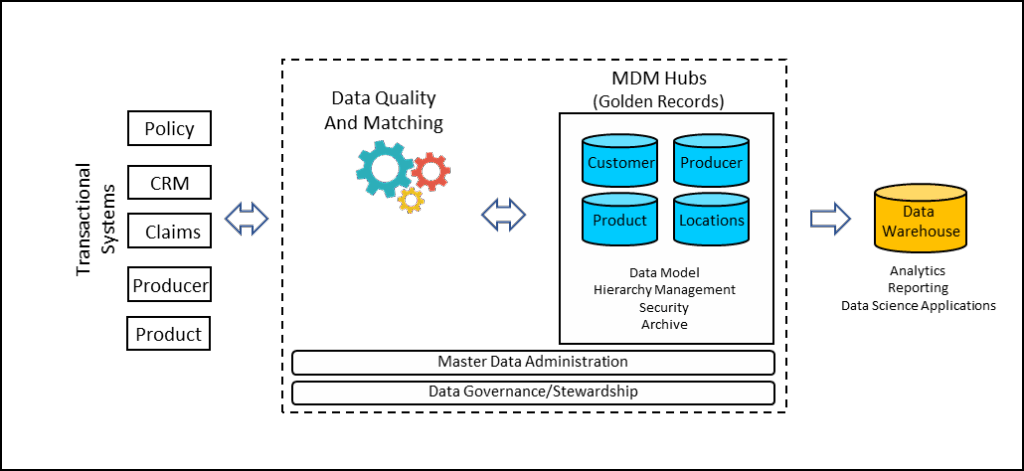
MDM solutions focus on creating and maintaining a single source of truth, or golden record which is then synchronized and integrated with a wide variety of operational systems throughout the enterprise such as Customer Service and Call Center systems, Billing, Claims etc., to ensure that all systems have the same version of the data.
MDM provides the authoritative foundation for all information across the enterprise and a single source of truth, with the aim of building a “golden record” that has the approved version of the latest and most important data about customers and other business domains.
Gartner defines MDM as “a technology-enabled discipline in which business and IT (Information Technology) work together to ensure the uniformity, accuracy, stewardship, semantic consistency, and accountability of the enterprise’s official shared master data assets.”
This is in recognition that master data management is not just a technology issue. It requires business leadership, stewardship, and processes to ensure on-going accuracy, reliability and consistency of an organizations master data assets.
Most modern MDM platforms include tools for data governance and stewardship. Stewardship is a set of processes and policies that run on top of the hub. They include data entry (for fixing data into the hub), duplicates handling (for false matches or specific matching cases) and rejects management. Data governance and stewardship teams are responsible for collectively determining the policies, validation, and data-quality rules, as well as service level agreements for creating and managing master data in the enterprise, as well as meeting compliance and regulatory obligations.
Implementation styles for MDM
When MDM is only used for data and reporting purposes it is referred to as Analytical MDM. In this case, it creates master records and master IDs that feed downstream reporting and analytics systems. The master record data is not usually synchronized back to the source operational systems in this model.
Operational MDM refers to when the source systems are also updated or able to access the mastered record. For example, the source system may capture a particular customer on a transaction. After the MDM system has matched and identified the golden customer record, the source system can be updated to reference the corrected ‘golden’ customer record going forward. This is usually the primary use-case for implementing MDM today.
Depending on the scope of the MDM initiative, there are several common MDM implementation styles that support various combinations of operational and analytical MDM use-cases. The most important styles in use today are the Consolidation, Registry, Co-existence, and Centralized Styles. These are explained further in our whitepaper. The newer generation of MDM vendor solutions can support multiple implementation styles at once, depending on your unique circumstances.
The evolution of Customer MDM
Customer Master Data Management began with the goal of integrating silos of customer data across an organization’s IT landscape. The aim was to build a golden record of each unique customer with complete, accurate and current data elements that describes that customer. The technologies involved were heavily based on identity resolutions, data matching / de-duplication capabilities developed primarily for optimizing marketing campaigns.
The technology has evolved and expanded over time and is now uniquely positioned as a key enabler for digital transformation with the ability to provide a comprehensive 360-degree view of customers by combining customer master data with other master data entities, by incorporating data from external sources including real-time digital channels, and including hierarchies, reference data and data insights.
What about Customer Data Platforms?
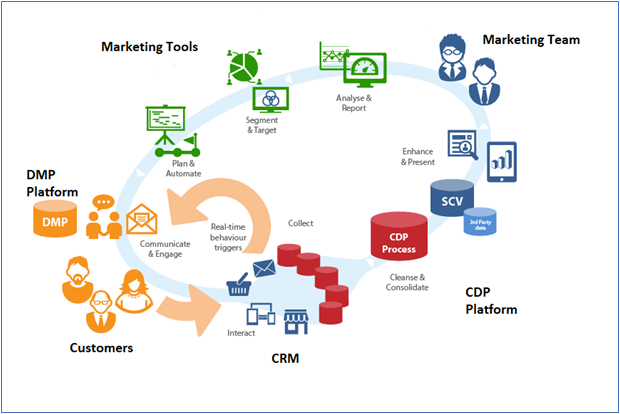
Traditionally, marketing and sales have relied on their own technology stack for acquiring and tracking customers. This stack is commonly referred to as MarTech. Most notably Customer Relationship Management systems (CRM), Data Management Platforms (DMP) and more recently Customer Data Platforms (CDP).
MarTech stands for marketing technology. It is heavily focused on CRM and digital marketing. Since 2011 the market has grown by 5,233% from 150 solutions in 2011 to 8000 today. It represents a $121 billion industry (Chiefmartech.com).
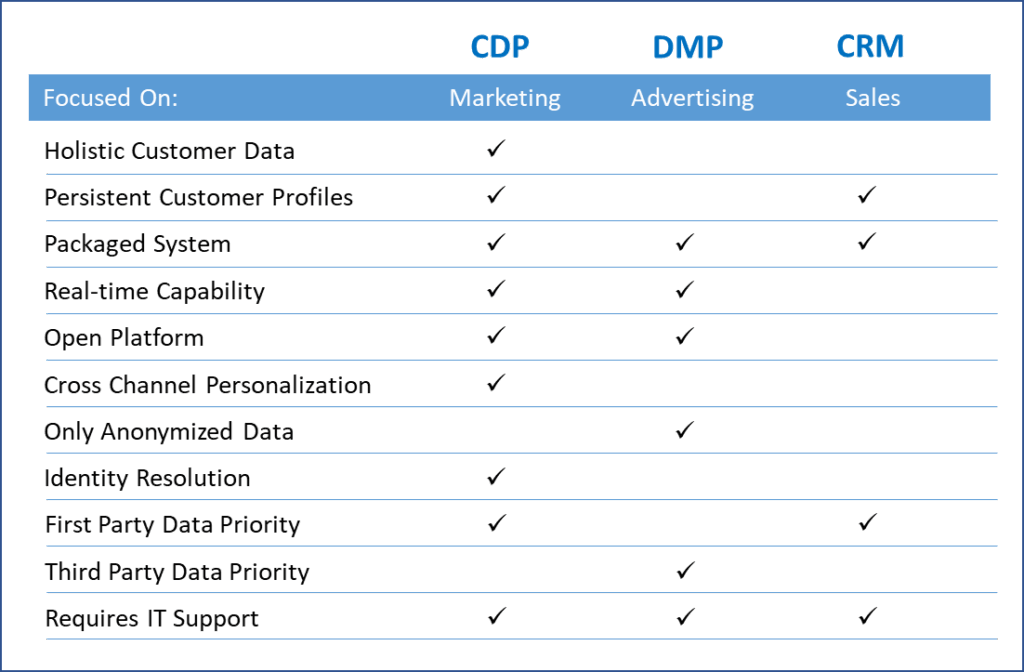
Customer relationship management (CRM) platforms were amongst the earliest MarTech solutions to hit the market. They were introduced to assist sales and marketing professionals to manage their direct interactions with customers. Data management platforms (DMPs) gained popularity in the 2000’s. DMPs are advertiser-focused and primarily used to help inform and feed data driven marketing campaigns. And now, we have customer data platforms.
Gartner defines Customer Data Platforms (CDPs) as “marketing-managed tools designed for the creation, segmentation and activation of customer profiles.”
They were introduced as a reaction to the increased focus on customer experience and omni-channel marketing and the realization that the siloed nature of marketing technologies prevented a 360 view of their customers across all channels.
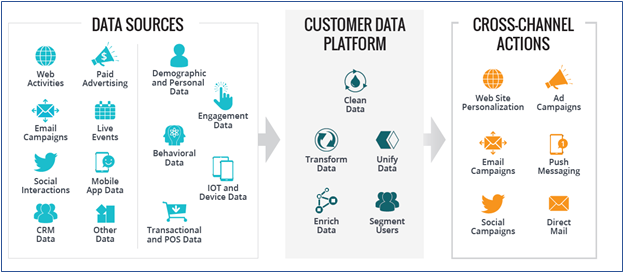
Customer Data Platforms (CDP) build a complete picture of customers on an individual level. They collect customer data (transactional, behavioral, demographic) from a multitude of sources and systems including email, social media, advertising, CRM, instore visits, IOT etc., and link that information to the customer that created it. The data is imported, cleansed, and unified into a 360-degree customer profile, also called a single customer view.
Many CDPs provide a user-friendly interface to group the customers and create a targeted audience segment which can then be used by 3rd party tools or built-in marketing automation tools to execute marketing activities such as personalized web pages, emails, offers and more. Some CDPs provide AI / ML driven segment recommendations such as potential leads, potential conversions, potential product recommendations, etc.,
The beauty of a CDP solution is that it can rapidly empower the marketing team to realize a coherent, trustworthy, and persistent ‘Golden Record’ from many data sources, without needing a team of engineers or IT professionals to manage it.
CDP Vendor Comparison
According to the Customer Data Platform Institute there are at least 133 CDP vendor solutions on the market.
Key features of most CDP solutions include:
Provide a 360-degree view of the customer
Gather data from multiple sources into one platform, including first-party, second-party, and third-party data from online and offline sources
Unify customer profiles across systems
Support dynamic profile segmentation
Integration with other marketing systems for targeted marketing campaigns or Ad servers (DSPs) for online advertising
Comparing Master Data Management solutions to Customer Data Platforms
CDPs are packaged software solutions built for business users (mostly marketers), that connect to all customer-related systems. While they do require some technical resources to set up and maintain, they do not require the level of technical skill and overhead of a typical MDM implementation.
A CDP deals with customer data, primarily to support the marketing team. As with an MDM solution, it collects, cleanses, de-duplicates customer information and will create a singular customer record along with information of all customer interactions with your brand across all marketing channels. It is designed for management of marketing campaigns through segmentation and data analysis, campaign automation and customer journey management and integration with email platforms, online advertising solutions and real-time personalization tools.
CDP’s are quick to implement and can create a single customer record and a Customer 360 view from internal customer systems as well as digital sources. They are designed on modern cloud based digital platforms and can ingest large volumes of data required for modern digital marketing and customer experience.
It is difficult to directly compare CDP’s to MDM, since MDM has a much wider scope.
MDM is truly an enterprise enabling technology focused on creating and managing a ‘single source of truth’ for multiple business master domains including customer. MDM is not only for analytical uses but also intended for operational use with 2-way synchronization with other systems so that mastered data can be propagated to other transactional systems throughout the organization, so that the whole organization has a single view of the truth. In addition, MDM is founded on core data management principles of metadata management, data standards, data quality management and data governance.
All of this has traditionally made MDM complicated and expensive to implement, however with newer 3rd generation MDM solutions the barrier to entry has been lowered with the introduction of subscription-based pricing and simpler entry-level and cloud based solutions allowing a viable “start small and grow” approach.
The Bottomline
Ultimately, it appears that both CDPs and MDM have their own place in the solution landscape of a modern digital organization. Despite confusing marketing and sales literature about CDP’s as the enterprise solution for customer experience and customer management, they are in fact focused on marketing only. What a CDP does really well is gather to a lot of customer data from various sources, correlate it and segment it for marketing purposes. They are designed for easier integration with downstream advertising and marketing systems. MDM focuses on more than just customer data and is a true enterprise solution designed for integration with operational and analytical systems throughout the organization.
The risk for organizations that already have MDM or are trying to implement MDM, is that the CDP may introduce yet another data silo or alternative single customer view.
Forward thinking MDM vendors such as Reltio, who are expanding their cloud-native offerings to include digital data streams and extended customer 360 views are building and promoting capabilities to integrate with CDP’s so that the MDM platform is used to supply clean, accurate and up-to-date master customer data to the CDP. The CDP then focuses on segmentation and direct marketing. This appears to offer a best of breed of approach, where the same golden master record is shared throughout the organization including the CDP, and the CDP can still be used as a powerful marketing tool for customer experience analytics, segmentation, managing marketing campaigns and digital advertising.
Which technology you finally select will be driven by your use-case and desired outcome. Exavalu is uniquely qualified to help you navigate the MDM and customer data management landscape and quickly unlock value.
Exavalu as your Customer Data Management Partner
Exavalu is a unique Business Advisory and Technology Consulting firm run by seasoned industry veterans consisting of former executives, CIOs, CXOs, and Consulting Principals focusing on digital transformation strategy and solutions.
Our Customer Data Management services include:
1. Customer Data Strategy and Roadmap
We help our clients define an integrated and holistic customer data strategy that incorporates your digital transformation and customer experience objectives as well defining the future state technical architecture, and core data management tools and capabilities needed for success. For example, in one of our engagements for a large personal lines insurance carrier we defined not only the end-state architecture for MDM and customer 360, but also the data governance structure required to ensure the long-term success of the initiative.
In mapping out the roadmap for implementation of your customer strategy implementation, we ensure that there is strong interlock with other digital transformation streams and a focus on early business value capture. Our approach can best be described as one that incorporates short-term quick hits to address ‘low hanging fruit’ opportunities while also building out the necessary architecture, tools and capabilities to address long term goals.
2. Vendor Selection and Evaluation
Using our structured assessment and evaluation process we have assisted several clients in selecting the most appropriate MDM or customer data management tool for their needs. Our process begins with clarifying the strategic objectives of your customer data initiative and then defining the primary business use-cases that support it. Then we help you to define the technical and functional requirements for your solution needs, and important vendor assessment criteria. From our knowledge of the solution marketplace, we can help to create a short-list of suitable vendor solutions for evaluation. Our end-to-end process includes:
Requirements Definition
Creation of RFI and RFP documents
Vendor Selection Scorecard and evaluation criteria
In efforts to combat rising costs, decrease cycle time and streamline Total Loss and Salvage claims operations, the scope of this study was to examine and advise on alternative Total Loss and Salvage Claim processing solutions as well as identify process improvement opportunities for our client, a leading P&C insurance carrier in the United States.